Showing posts with label FILM ANALYSIS. Show all posts

Thursday, October 22, 2015

Film Analysis Koyaanisqatsi


Film Analysis Koyaanisqatsi  

Student’s name:   Yanira Garcia
Theme: Film analysis of the film Koyaanisqatsi  
Date: October 4 2015
Film Title: Koyaanisqatsi
Director´s name: Godfrey Reggio
Country: NEW YORK
Year: 1983

- Description.

A collection of expertly photographed phenomena with no conventional plot. The footage focuses on nature, humanity and the relationship between them.

- Synopsis.

This movie was realized between years 1975 and 1982, This is a original documental of 87 minutes, create with a creative format because this don´t have locution, only was producer with image and music made by a minimalist sound blaster band of fillip glass. The production has an uncountable audio and visual effect that becomes this documental in a piece of art. In it you can see a series of beautiful and impacts images with the intention to create impact in the public.


- Conceptual Analysis of the film:

This movie shows the coalition between two worlds that is force to live in the same planet, result of human developed. Shows many professional video clips of nature and environment made with many ways, aerial shots and different angles shots in contrast with a lot urban shots, that presents the human in the modern society, the occidental live full of technology, science and consuming. Power images and impact music is the best combination in this realization.


- Personal Analysis and Reflections:

This documental is a critical to the modernism and the mass media, the intention for show us the first images full for many beautiful shot of nature, they part seek to create reflection in front of this planet with out human intervention, formed by graceful and marvelous landscapes and figures that current, we are change by blocks and jungle concrete and for many products, brand and fetishes. In the movie those magnificent images change to awkward image like commercial center full of people eat fast food of the boras way, and many people in the street, walk the fast way to go to the place work, and many images of cars in heavy traffic, and fabrics that expel smoke, etc. That images are very hard because you can see like a mirror that show the disgusted stage that we live every day in the world that we have create. 


- References.
Koyaanisqatsi - Kizökkent világ. from Merényi Zoltán 4 years ago Not Yet Rated. https://vimeo.com/21922694


Film Analysis Der Name Der Rose


Film Analysis

Student’s name: Carolina Hernández Vargas
Theme: Season
Date: 1986
Film Title: Der name der rose
Director´s name: Jean-Jacques Annaud
Country: Alemania, Francia and Italia
Year: 1986


1. Conceptual Analysis of the film: three paragraphs.

It is a film that tells a story of the XVI century, developed in Italy, where after a series of crimes committed in a Benedictine abbey, a Franciscan monk and his disciple arrives for the investigation of these facts.
Apparently there have been a number of suicides and nobody knows why.
Behind this they realize that there is a secret book, perhaps forbidden which senior monks did not want people to know of their existence.
Acts committed in the monastery are related to evil forces, making two congregations come here to meet with delegates of the pope, to ascertain whether the Church should follow the path of poverty and accumulate wealth for the greater glory of God.
He also brought an inquisitor is to stop the diabolical situations and teach respect God heretics.


2. Personal Analysis and Reflections: two paragraphs.

This film mainly as the Catholic Church had a strong impact on the thinking of society.
Furthermore, what is observed is a punishing church, above the freethinking wants his disciples to be obedient and have faith that their ideas first.
Through the Inquisition the church order of the state and society are imposed.
The economy was destabilized in part by the emperor and the church.
The separation of the social life of these monks makes in his personal life situations that go against what the church commands are given.
While passing situations that are visible to the eyes of superiors ignored, the fact that monks paid with food for a woman for sexual favors.
But also the role of women is seen very low way, the woman is considered a worthless being.
A troubled society know that if Jesus was poor or not, in any case, anxiety stems from the idea that it can take shape among the faithful about whether to be poor or not the Catholic church is shown.
Some knowledge appears as an offense to the Catholic Church, outside of religion, not freedom of thought allowed.


References


Monday, October 19, 2015

Der Name der Rose Film Analysis

 Der Name der Rosa


Film Analysis
Student’s name: Luz Stella Deaza Muñoz
Theme:  Analysis of the film der Name Rose
Date: October 2- 2015
Film Title: Der Name der Rosa
Director´s name:
Country: Jean Jacques Annaud
Year: 1986


Fuente: Ova- EAN (2015)


Quote from the film:
The film “der Name Rose” is a production based on the novel by Umberto Eco and published in the year 1980, a co-production between Italy, West Germany and France, lasting about 126 minutes, in English, and its economic budget is about $ 20 million. The making time of the film was about five years.

The plot is developed in the year 1327 (XVI century), a period called "obscurantist" where the church maintained its hegemony, but the reason. The thought was beginning to take its first steps. The monasteries where the film takes place in a Benedictine abbey, where mysterious murders are hidden occur without valid reasons. Scenarios that transports the beholder to the middle age, an era of inquisition and feudal age. A large library is the most important and mysterious place of the film. There are books written in Latin on parchment, indecipherable labyrinths, a big cold, and the whole repression used by the church.

Its director Jean Jacques Annaud Starring: Sean Connery, Christian Slater, Helmut Qualtinger, Elya Baskin, Michael Lonsdale, Volker Prechtel, Feodor Chaliapin Jr., William Hickey, Michael Habeck, Urs Althaus. Script: Gérard Brach, Andrew Birkin, Alain Godard, Howard Franklin. Distribuidora 20th Century Fox Studio: Films Ariane, Zweites Deutsches Fernsehen (ZDF), Radiotelevisione Italiana, Neue Constantin Film, Cristald iFilm, France Cinema 3.

Conceptual Analysis of the film

The history of the movie “in the name of the rose”, is developed in the sixteenth century. Begins with the arrival of two Francis monks to a Benedictine monastery. William of Burkesville and his young charge: Aldso De Mesk arrive to attend a summit meeting of the clergy, which seek to establish if Jesus Christ was poor or rich. In turn the abbot asked to the monk "William of Baskerville" to decipher a series of murders that has been presented at the abbey in recent times.
William reflects the modern man, educated and prepared academically. With this training the monk is able to carry out research using the scientific method known for this time.
William and Aldso begin their journey in the midst of a feudal system where all the monks living in the abbey must perform different activities. Some work on tasks such as: agriculture, various trades, care of the house. But other monks are devoted to studying and writing in a mysterious and full of mazes library. Insight and William reason, along with the unconditional support of Aldso take them discover that the murders have been carried out in a very particular way. All monks have been killed have remained long in the library. This is a sign that reflects the dominance of the church, and how to preserve its hegemony subjected the people to ignorance and fear. Knowledge, joy and pleasure was a grave sin for the church, so that he who come to read forbidden books was accused of heresy. (Cause of the killings, discovered by Aldso and William). The fear for the church was that knowing science lead to the disobedience of the people to know their farce. The library contained books that very few monks had access. Another very important issue that the film tells us, is the forensic technique used at this time because the bodies were analyzed by intuition rather not by knowledge or reason.
And finally, the practices of torture and murder carried out by the Holy Inquisition that as the film shows, the defendants were required to qualify as guilty and take the blame, facts that supported the realization of the most heinous crimes and torture in the name of God".

 Personal Analysis and Reflections

The Film is an evocation of the dark ages, where the church owned the power, avoiding no matter what the freedom of thought. However, despite all crimienes who performed the church in the name of "God" begins to lose control.

 As stated by Parra (2005) the man begins to establish the reason, pass from a cosmocentric view of reality to an anthropocentric vision. The plot around the film shows how the man begins to discover himself as the center of the world. The story goes back to the fourteenth century, here reflected a medieval thinking, starting crashes between politics and the church for the power, however, also the feudal period had its power, where everyone works together to the general welfare. Another interesting facet is the love, tenderness and desire that made Slater change his paradigms and feels like a man of flesh and blood, he is able to feel the desire and the passion for a woman.


It's a pretty interesting story because through the crimes committed there in thought-provoking topics as Machiavellian as they were: the "Holy Inquisition" as a regime of terror. But also through the mysterious deaths it gives way to research and intuition, and the very history of humanity through time. William of Baskerville embodies the rational, anxious and able to change the destiny of the mankind.


Calinescu,  M. S.F. Cinco caras de la modernidad. Modernismo, vanguardia,
Decadencia, kistch, posmodernismo. Recuperado de: http://goo.gl/BIwR9G

Dussel, E. 1993. Europa, modernidad y eurocentrismo. Recuperado      de          http://goo.gl/9JAEzr
           
Eichinger, B. (Productor) y Annaud,  J. (Director) (1986). En Nombre de la Rosa
            [Película]. País de Origen: Italia, Francia, Alemania Occidental: Constantin
            Films De Ariane-Cristaldi Film-.

Habermas, J & Ben- Habib, S. 2008. Modernity versus.Recuperado:
  Postmodernity. http://goo.gl/dsgl9C

Garcia Márquez (1994),     Discurso:     Por un país al alcance de los niños:

Jiménez, J. SF. Algunas notas sobre el concepto de Modernidad.
Recuperado de http://goo.gl/KmZfmR

Miras, J. 2013. Marx y la modernidad Presentación de una conferencia de
            Enrique Dussel. Recuperado: http://goo.gl/xmnJyW


Parra, F. 2005. Modernidad y postmodernidad: desafíos. Chile: Red PHARO. 

Tuesday, October 13, 2015

Modern Times Film Analysis

By: Catalina Echavarría

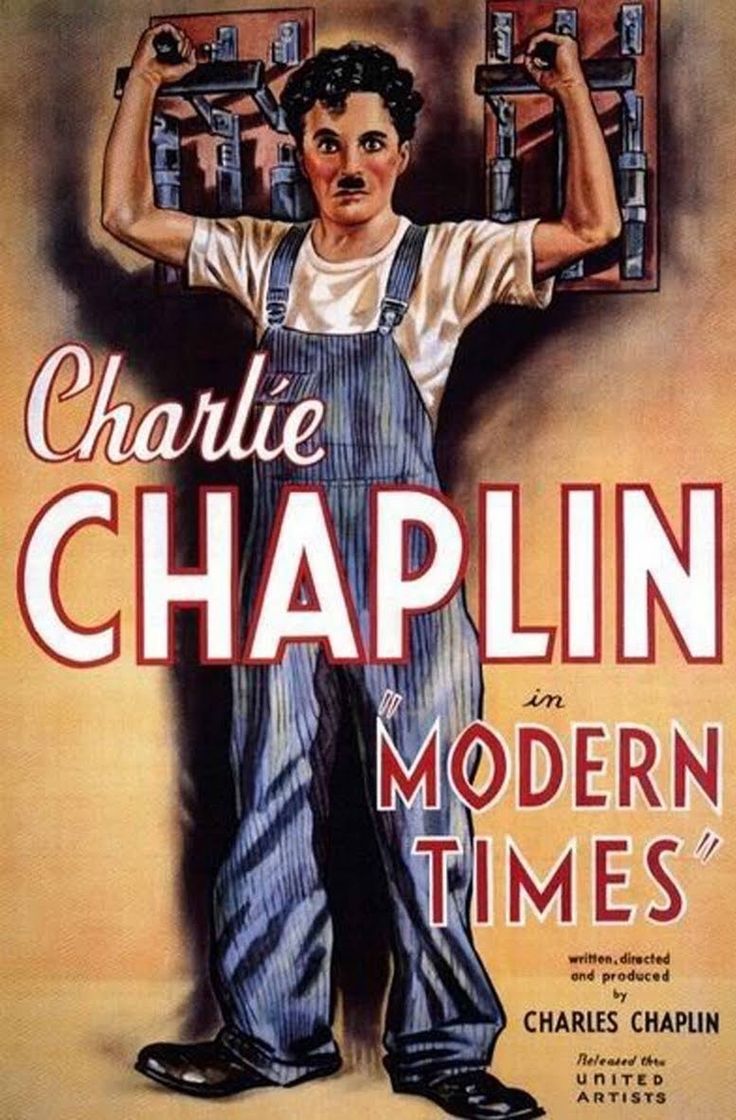
Modern Times (Chaplin, 1936) is a film directed and starred by Charles Chaplin. It depicts the hardships of a low-class worker in the industrialized Post-Depression era in the United States of America.


Factsheet
Film Title: Modern Times
Director´s Name: Charles Chaplin
Country: United States of America
Year: 1936


Plot
The factory worker (commonly known as the Tramp or Charlot in previous movies (Robinson, 1985)) screws bolts onto pieces of machinery at an ever-increasing rate, unable to cope, he ends up being engulfed by the mechanism, halting the production line. His task is so mechanical, that after the shift, he behaves like a robot, mimicking the same frantic moves repeatedly. While on the factory, he serves a guinea pig for a force-feeding machine and later suffers a nervous break-down, ending up in a hospital.


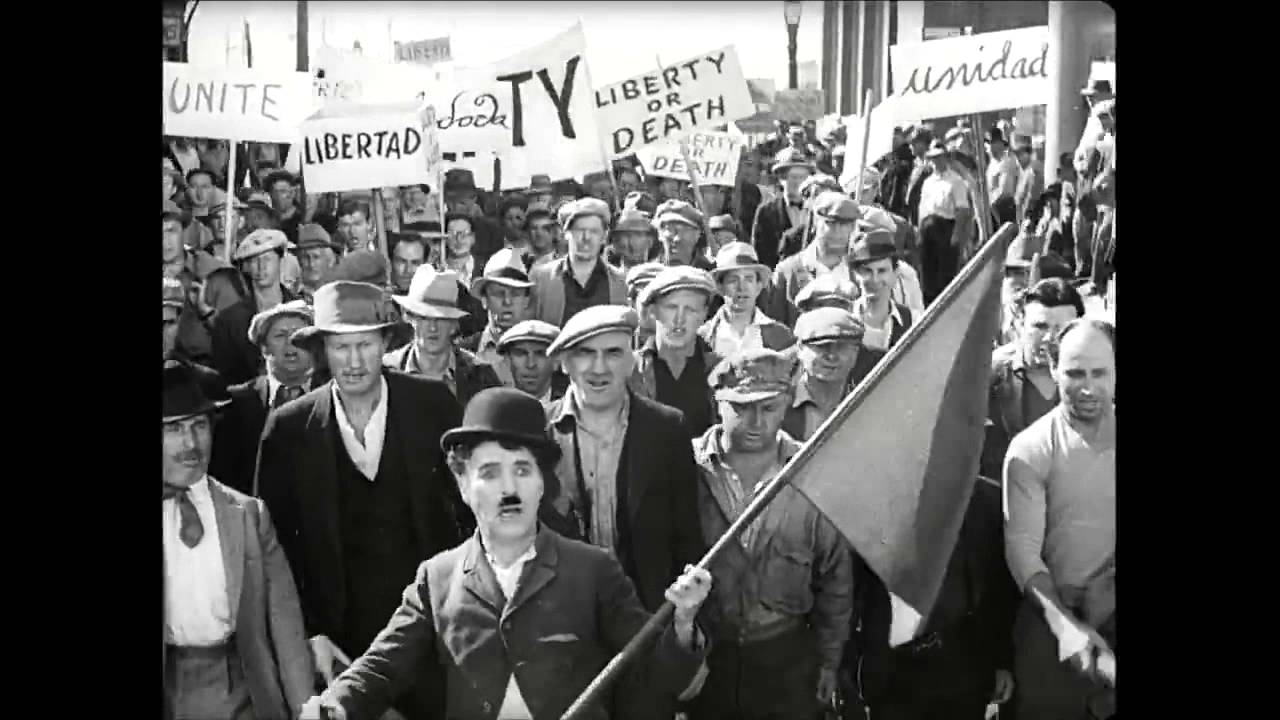
After his discharge, he finds himself among demonstrators fighting the economic system, and is mistaken for a communist leader, thus being arrested and sent to jail, where he unwillingly consumes smuggled cocaine. In his delirium, he stops a jailbreak and is regarded as a hero. “Happy in his comfortable cell” (Chaplin, 1936), he is released from prison despite his plight: “Can I stay longer? I´m so happy here” (Chaplin, 1936).


He meets and orphan girl (Ellen or the Gamin (Robinson, 1985)) while trying to go back to the penitentiary, taking the blame for the bread she stole. He finally gets caught after eating a full banquet without paying and meeting Ellen in the paddy wagon, before she escapes and convinces him to go with her. They dream of a better life where food and a household are granted, and he gets a job as a watchman in a department store. Burglars break into the store and he recognizes one of his former coworkers, Big Bill, who explains they are starving. After a merry feast together, the Tramp is locked again.


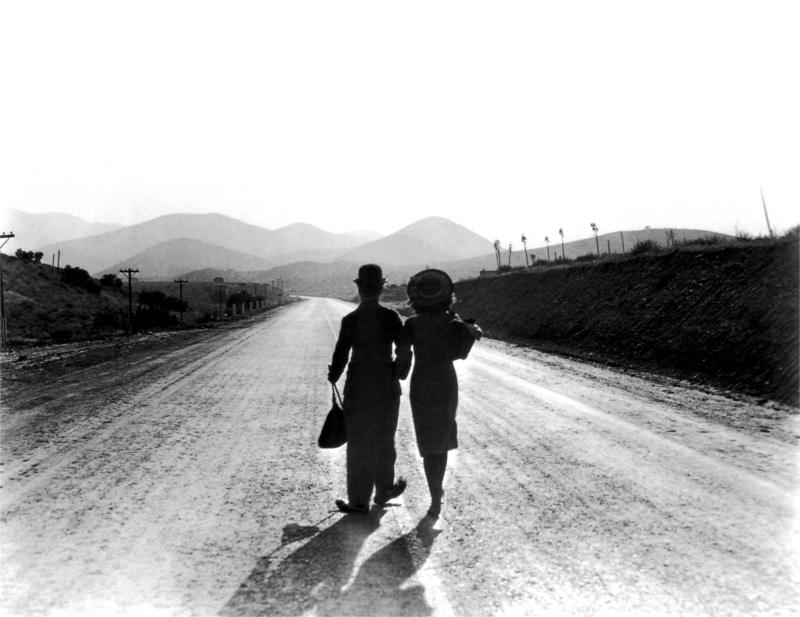
Upon his release, Ellen takes him to a shack by the waterfront, although she admits “Of course it´s no Buckingham Palace” (Chaplin, 1936), they are both happy to have a place of their own. The workers strike at the factory is finally over, and the tramp is able to get a job again, but fails miserably as mechanic assistant, that same day riots break out and he is jailed once more. Two weeks later, Ellen lands a job as singer and arranges for the restaurant manager to hire the Tramp. After dreadfully serving tables, he successfully performs as singer, but police arrest Ellen on the spot. They manage to escape and walk down a road to an uncertain but hopeful future together.


Conceptual Analysis
Modern Times is a film where the post Great-Depression struggles of the working class is clearly depicted. It was Chaplin´s last “silent” movie, even though it contains a few audible dialogues, they are all gibberish and unintelligible, which attracted critics for being “outdated” (Robinson, 1985). There are however written signs all along the film to highlight the most important messages given to the audience. It is also noteworthy that all of the newspaper headlines speak of riots, unemployment, strikes and general unease about the economic situation.


Some scenes speak eloquently about the hardships of the times: the waterfront kids scavenging for food and collecting rubble to survive, the unemployed turned burglars for food, the happiness of being in jail where basic needs are met in spite of a so-called freedom, and the obvious analogies of the man-eating machines. The role of food is central throughout the movie, not only because of the machines engulfing workers or force-feeding them, but also because of the general scarcity (the Tramp, Ellen and unemployed are on a constant battle against hunger and starvation (Stephens, 2011)).


The film is a political comedy, highly critical of the economic system and the dehumanization of capitalism, where workers are regarded as replaceable pieces of machinery. The clear disparities among the upper-class and lower-class is evident too:  owners who don´t really work and try to stay as far as possible from their employees as possible, rich ladies who can afford delicacies and expensive fabrics, and patrons who dance among whisky and roast duck.


Personal Analysis and Reflections
Modern Times serves as an important reminder of the need to preserve humanity in a mechanized, modern world; where capitalism has proven to fail at creating general welfare and abundance for everyone; where economic inequality, the tyranny of the machine, and the need for drugs and alcohol as a way to escape reality . It also depicts the climate after the Great Depression, the period between the First and Second World Wars, in which pessimism and uncertainty about the future were ubiquitous.


Charles Chaplin was very critical of the economic and social issues of his time, he satirizes industrial capitalism through stark humorous and paradoxical portrayals of the progress of laissez-faire economic policies. The opening sequence, in which a herd of sheep are juxtaposed with workers heading to the factory, symbolizes the subordination to the economic system: confined to a pen (the factory), surrounded by fences, relying on incentives for their livelihood, and knowing they have been domesticated to be replaceable (Connerly, 2009).  


References:

Chaplin, C (Director & Producer). (1936). Modern Times [Film]. United States of America: United Artists. Available at: https://www.youtube.com/watch?v=_jLHVT0-GgM
Connerly, A. (2009). Charlie Chaplin´s Modern Times and the Abstraction of Labour. Available at: https://aconerlycoleman.wordpress.com/2009/11/17/draft-charlie-chaplins-modern-times-and-the-abstraction-of-labour/
Robinson, D. (1985). Chaplin: his Life and Art. London: McGraw-Hill.
Stephens, G. (2011). Biting Back at the Machine: Charlie Chaplin´s Modern Times. Melbourne: Senses of Cinema. Available at: http://sensesofcinema.com/2011/feature-articles/biting-back-at-the-machine-charlie-chaplins-modern-times/